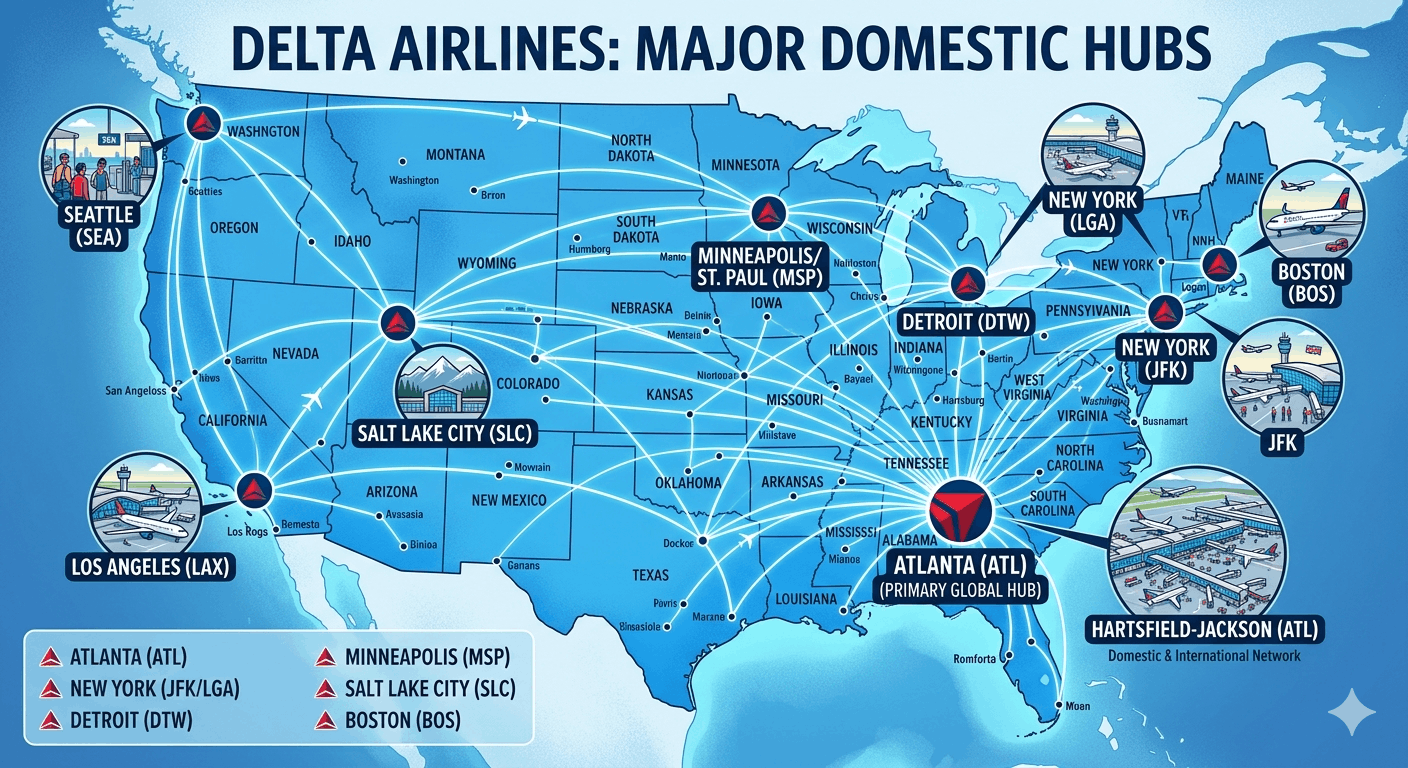
As of the statistics of February 2026, Delta Airlines boasts a market capitalization of Rs. 4.076 trillion. This trend makes Delta Air Lines the world’s 542nd most valuable company by market cap. Delta hubs are the strategic nerve centers that connect passengers to a wide network of destinations. Delta Airlines generally operates over a huge network of Delta hubs located across the United States. These serve as pivotal points for connecting flights while making you experience seamless travel.
Such Delta hubs are necessary for the operations of the airline while helping in improving efficiency and profitability. Let us explore more about the major Delta Airlines Hubs and their viable evolution.
The Incredible Evolution of Delta Hubs
Recently, Delta Airlines has been operating over 4000 flights on a daily basis. It serves over 275 destinations across six major continents. The airline is famous for pioneering the hub-and-spoke system in the aviation industry. This includes connecting flights for smaller airports to a centralized hub airport.
- The following system is known for serving cost-efficiency and profitability as compared to the point-to-point system.
- Some of the effective Delta hubs that we know today originated from former airlines that Delta acquired in the past.
- Delta Airlines started in 1925 as Huff Daland Dusters. This is the first crop-dusting company battling cotton crop pests. This was led by C.E. Woolman.
- Further, Delta empowered itself and began passenger flights in 1929. However, it stopped serving due to losing an airmail contract.
- Delta resumed its operations by 1934 and became Delta Air Lines in 1945. Further, the company grew undeniably, launching international flights in 1953.
- Acquisitions like Northeast Airlines in 1972 and Western Airlines in 1987 broadened its network. By 1991, the airlines dominated trans-Atlantic routes, and in 1997, they covered 100 million passengers yearly. This is how the airline enriched its capabilities while strengthening its global presence.
Prominent Delta Airlines Hubs
Within the US, Atlanta is serving as the primary hub. Moreover, such hubs are not only limited to the USA but are also available globally. Here, you can go through some major Delta Hubs that have been serving integrity to the airlines.
Hartsfield-Jackson Atlanta International Airport
- Being Delta’s primary hub, ATL works as an integral gateway that connects passengers to over 200 destinations.
- With a series of dining choices, shopping spots, and lounges, ATL offers travelers a broad range of services.
Detroit Metropolitan Wayne County Airport
- DTW works as the secondary hub of Delta while enabling connections across the Midwest and beyond.
- As a traveler, you can unwind with a series of dining options, duty-free shopping, and relaxation sections at DTW.
Minneapolis-Saint Paul International Airport
- This is one of the most essential hubs for Delta that connects passengers to several destinations around the Upper Midwest and beyond.
- Being a key hub for Delta Airlines, it handles around 70% of the airport’s passenger traffic.
- It also plays a critical role in the local economy while contributing around USD15.9 billion annually. Further, it offers employment for 87,000 individuals.
Salt Lake City International Airport
- Being a critical Delta hub, SLC offers a crucial gateway to the Intermountain West and beyond.
- It offers its travelers a wide range of amenities that include shopping outlets, dining options, and art installations that highlight local culture.
- This hub is situated just 4 miles from downtown Salt Lake City, and it handles over 343 daily nonstop departures to 93 cities across North America and Europe.
John F. Kennedy Airport and LaGuardia Airport
- Delta generally operateInternationals from two of the most dynamic airports in New York.
- It features a grand host of international routes with LaGuardia that prioritize domestic connectivity.
Seattle-Tacoma International Airport
- This is one of the Delta’s newest hubs that is opened mainly for its operations on the West Coast as well as several international flights.
Why Delta Airlines’ Hub Strategy is Important to Most of the Travelers?
Delta’s hub network is not just about airport locations. It is about how effectively passengers move from one destination to another.
- A well-curated hub system accesses Delta’s leverage, shorter layovers, and better flight frequency, along with more reliable connections.
- For travelers, this often means fewer missed connections and more flexibility when you book flights.
- Unlike point-to-point airlines that prioritize majorly on direct routes, Delta uses its hubs to link smaller and regional airports with major domestic and international destinations.
- These valuable strategies enable travelers from mid-sized cities reach global locations without the requirements of changing airlines.
How Delta Hubs Encourage On-Time Performance?
One reason Delta consistently ranks high in on-time performance is its strategic hub placement. The Delta hubs have been present in regions where weather disruptions generally don’t occur as compared to other US airports.
- Delta generally schedules longer connection windows at busy hubs. This step might increase the layover time. But it can minimize the chances of passengers missing their flights due to any type of delay.
- People catching frequent flights might find this approach reliable while making a noticeable difference in their lives.
The Experience of Passengers at Delta Hub Airports
Delta majorly invests in improving the experience of the passengers at its hub airports. Starting from upgraded terminals to modern lounges, the airlines prioritize comfort as much as valuable connectivity.
- Most of the Delta hubs highlight Delta Sky Clubs, delivering travelers access to quiet workplaces and complimentary food and drinks.
- Such amenities are valuable for passengers on long-haul or connecting flights. Airports like Atlanta and Los Angeles have also seen major renovations.
- Such updates have been aiming at reducing congestion while improving navigation.
- This makes connections seamless even during peak travel hours.
Future Expansion of the Hubs
Delta Airlines continues to leverage long-term investments in its hub airports to keep pace with rising passenger requirements and changing travel patterns.
- The airline is mainly working on its gate capacity. This approach is modernizing the infrastructure while supporting effective operations with quick connections.
- Such improvements are curated to make your travel experience more efficient and comfortable, instead of just handling more flights.
- The Delta’s hub development is also adopting sustainability as its convenient source. Many hubs are strengthening their status through energy-efficient designs while enhancing their ground operations.
- Such efforts are valuing the commitment of Delta to grow responsibly while extending operational efficiency.
- The travel requirements of passengers have been changing with time. So, Delta remains flexible in how it operates the hubs. It majorly verifies the changing demands of the passengers to offer them the desirable services.
- It also strengthens domestic connectivity to ensure smaller cities remain effectively linked to major places.
- By continuously adopting new features and investing in its hub network, Delta positions itself to remain competitive in the rapidly changing aviation landscape.
- This futuristic approach encourages the airlines to adopt growth, efficiency, and passenger satisfaction.
In Conclusion
This is everything you need to know about Delta Airlines hubs, along with their locations. Delta’s hubs are not just transit points, but they are the backbone of the airline’s operations. By strategically positioning hubs throughout the United States and integrating them with international gateways, Delta is offering reliable connectivity. Further, it considers all the efforts to maximize operational efficiency while making your travel experience seamless.
For passengers, understanding Delta’s hub network can help you make your booking decisions smarter while reducing your travel stress. So, get ready to upgrade your journey planning!